Sea Cow
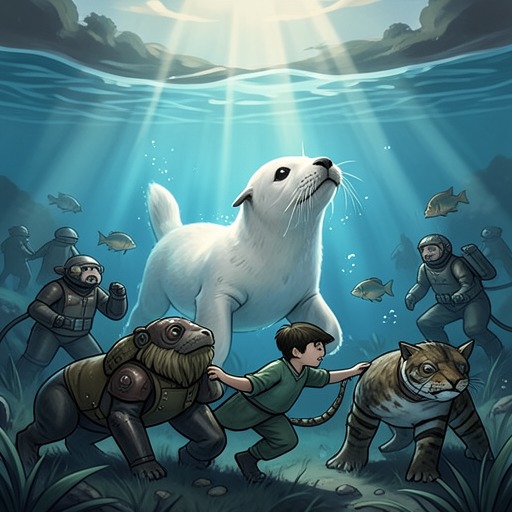
The Jungle BookSea Cow is the collective marine being who enables Kotick's search for safety to reach its decisive answer. After Kotick witnesses the killing of seals and finds that neither his father, Sea Catch, nor the other seals will challenge the established order, he searches the oceans for a refuge beyond human reach. Sea Cow does not merely confirm that such a refuge exists: the herd leads him through a submerged passage to beaches protected by cliffs, shoals, and deep water, transforming an impossible hope into a practical future for the seal people.
Discovery and Identity
Sea Cow enters the story indirectly, as the answer to a question Kotick has been pursuing since his first encounter with the killing grounds. When Kotick asks Sea Vitch how he can find a safe place, Sea Vitch directs him to Sea Cow, if Sea Cow is still living. Kotick remembers that direction years later, after traveling widely and failing to find either the creature or a suitable island. His eventual recognition of Sea Cow is therefore the culmination of a long quest rather than an incidental meeting.
The beings Kotick discovers are unlike any animal he has previously encountered. They are twenty to thirty feet long, have no hind flippers, and possess shovel-like tails; their heads appear foolish to Kotick, while their front flippers contain an extra joint. They graze among heavy seaweed, balance on their tails in deep water, and repeatedly bow to one another in solemn councils. Their strange appearance initially makes Kotick impatient and contemptuous, but the unfamiliar body that seems ridiculous to him proves adapted to knowledge and survival that the seals lack.
Silent Communication and Collective Knowledge
Sea Cow cannot speak. The narrative explains this physical limitation through the creature's six neck bones, rather than the seven said to be necessary for speech. Yet silence does not make Sea Cow unintelligent or inaccessible. By moving the extra joint in the foreflipper up and down and from side to side, Sea Cow produces a clumsy telegraphic code that serves as communication among the herd.
Kotick questions the sea cows in every language he has acquired during his travels, but spoken language fails because the herd does not answer in words. The encounter instead places the burden of understanding on observation, patience, and bodily signs. Sea Cow's knowledge is communicated through movement: the herd's councils, its route along a warm current, its sudden descent into deep water, and its passage through the submerged tunnel all function as a practical language. The creature is consequently more than a mysterious informant. Sea Cow represents a form of collective intelligence that does not depend on human speech or on the verbal conventions of the seals.
The Journey to the Hidden Rookery
Kotick follows the herd northward while it travels at only forty or fifty miles a day, stopping to feed at night and remaining close to shore. His impatience is intensified by the contrast between his own speed and the sea cows' deliberate pace. He swims around, above, and below them but cannot make them hurry. Their repeated bowing councils appear foolish until Kotick realizes that they are following a warm current, at which point he begins to respect their method.
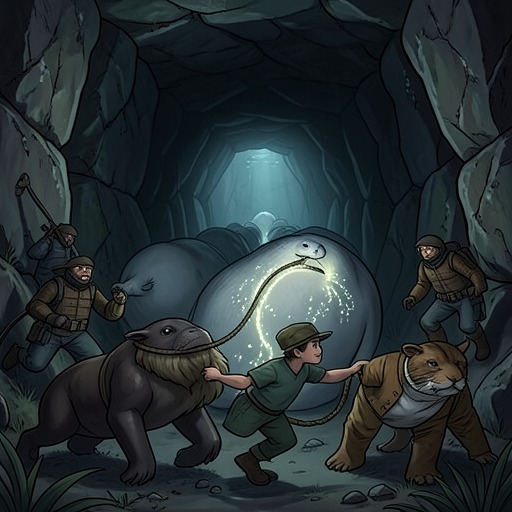
The journey changes suddenly one night. The sea cows sink through the bright water like stones and begin swimming with a speed Kotick had not imagined they possessed. They head toward a coastal cliff that plunges into deep water, enter a dark opening twenty fathoms below the surface, and lead him through a long underwater tunnel. Kotick emerges gasping into open water, but the difficult passage has carried him beyond the reach of the routes he already knows.
On the far side, the herd spreads out along beaches that Kotick recognizes as ideal for seals. Miles of smooth rock provide places for nurseries; hard-sand playgrounds slope inland; rollers, grass, and dunes offer room for the seals' characteristic activities. The water feels untouched by humans, and the surrounding geography makes that protection intelligible rather than magical. Low sandy islands lie within the fog, while bars, shoals, and rocks extend seaward far enough to keep ships six miles from the beach. Deep water separates the islands from the mainland, and the tunnel beneath the cliffs supplies the hidden entrance.
Consequences for Kotick and the Seal People
Sea Cow's guidance resolves the conflict that human indifference has made unavoidable. Kotick's companions had told him that the seals had always been driven to the killing grounds and that he should accept the practice as part of the day's work. His parents had advised him to grow into a large adult seal, fight for a nursery, and wait until age and strength gave him personal protection. Kotick refuses that narrow solution: he seeks safety not only for himself but for the seal people as a whole.
The rookery revealed by Sea Cow provides the material basis for that broader aim. It is not simply a place where Kotick can hide. It has food, breeding beaches, inland ground, play areas, and natural defenses against ships and human access. Sea Cow's knowledge therefore turns Kotick's solitary resistance into a collective possibility. The refuge's safety is produced by the relationship between geography and animal movement: cliffs prevent descent, shoals threaten vessels, and the tunnel permits the sea cows and seals to reach a protected shore.
Narrative Significance
Sea Cow's importance lies in the contrast between appearance and competence. Kotick initially judges the herd as ugly, badly mannered, and slow, but the creatures possess precisely the environmental knowledge that the seals need. Their seemingly absurd councils conceal careful navigation; their unusual anatomy gives them a communicative capacity of their own; and their silence does not prevent them from guiding another species toward survival.
The episode also gives independent agency to a nonhuman community. Human beings appear in the story chiefly through the organized slaughter witnessed by Kotick, while Sea Cow offers an alternative social order based on shared movement, patience, and an inherited understanding of the sea. The herd does not conquer the humans or argue with them. Instead, it opens a route to a world in which human violence cannot easily arrive. Sea Cow thus functions as guide, witness, and keeper of ecological knowledge: a quiet presence whose bodily difference and collective practice make a new future imaginable for Kotick and the seals.